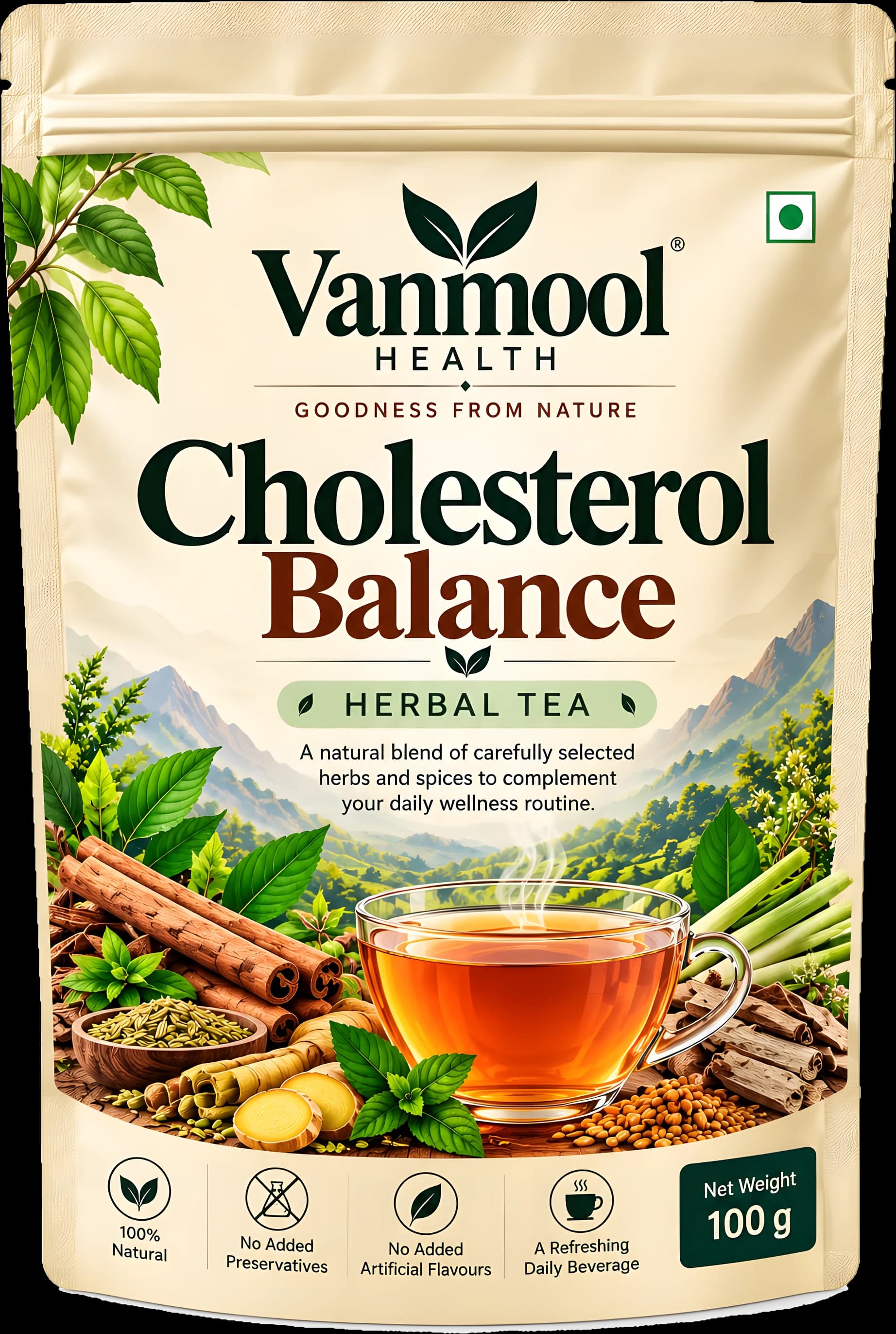
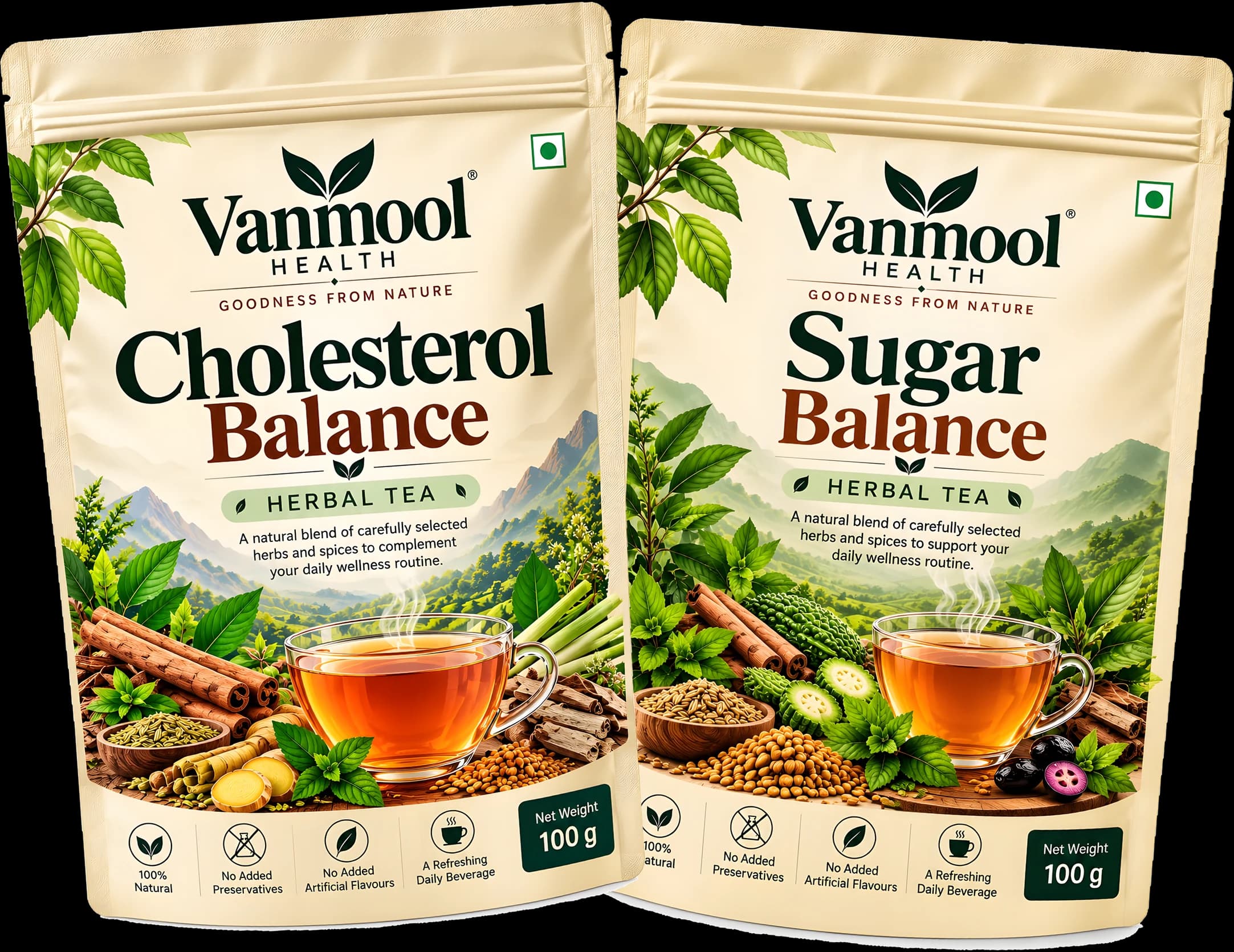
Green Tea Leaf ग्रीन टी की पत्तियां
The leaf of the tea plant, unoxidised, and the first ingredient in Cholesterol Balance.
Also called: Hari chai · Green tea ki pattiyan · Kahwa, in the Kashmiri cup · Camellia sinensis leaf. In English: Green tea.
Green tea is made from the leaves of Camellia sinensis, the same evergreen shrub that gives India its everyday black chai. The difference is not the plant but what happens after picking. For black tea the leaves are left to oxidise until they turn dark and malty; for green tea they are heated within hours of plucking, which stops that change and keeps the leaf green, fresh-tasting and closer to the living plant.
In India the bushes grow on hill estates in Assam, Darjeeling, the Nilgiris and the Kangra valley of Himachal Pradesh, where pluckers take the top two leaves and a bud every week or two through the growing season. The fresh leaf is withered briefly, then heated in a pan or with steam, rolled to bring its juices to the surface, and dried until crisp. The rolling decides the shape you see, from twisted strands to small curls.
Good green tea tastes grassy and lightly sweet, with a dry, mouth-puckering finish from its tannins. That astringency is the part that needs managing: the hotter the water and the longer the brew, the more of it comes out. Green tea also contains caffeine, as all tea from this plant does, which is why Cholesterol Balance, the only Vanmool blend with green tea leaf in it, has a little and Sugar Balance has none.
India's oldest green tea habit is kahwa, the Kashmiri cup in which green tea leaf is boiled with cinnamon, cardamom and a few strands of saffron, often finished with slivered almonds. It is a useful precedent, because it shows green tea doing well in exactly the company it keeps in Cholesterol Balance: warm bark and fragrant pods. Elsewhere it is drunk plain, steeped for two or three minutes in water just off the boil, or with a slice of lemon.
In a simmered blend the green tea is one voice among eight. It gives the cup its body and a clean, slightly drying edge that stops the sweetness of cinnamon and fennel from turning cloying, while mint and tulsi lift the top. Because the blend is covered and kept on a low flame rather than boiled hard, the leaf gives up its flavour without turning harsh. If a cup ever tastes too astringent, the usual cause is a fierce flame or an open pan, not the leaf.
Green tea is more delicate than black tea and fades faster once opened. Light, air, warmth and moisture are what dull it, and it readily picks up smells from nearby spices, onions or soap. Keep the pouch sealed, in a dark cupboard away from the stove, use a dry spoon, and avoid the fridge, where condensation forms every time the pouch comes out.
What has been studied about green tea leaf
Green tea is one of the most studied drinks in the world, which is not the same as saying the results are settled. Researchers have looked at it in connection with cholesterol, blood pressure, body weight, mental alertness and several cancers, mostly in populations that already drink a great deal of it or in trials of concentrated green tea extract taken as capsules. Much of the interest centres on its catechins, a family of plant compounds of which EGCG is the best known, and on its caffeine.
The findings are mixed. Public health bodies such as the US National Center for Complementary and Integrative Health describe the evidence for most of these uses as limited or inconsistent, and note that the clearer effects seen in some trials came from extracts at doses far above what a cup provides. A cup brewed from leaf is a food. It does not treat, prevent or lower anything, and nothing on this page should be read that way.
One finding runs the other way and is worth knowing: concentrated green tea extract supplements have been linked to liver problems in a small number of people. That has not been reported for the brewed drink in ordinary amounts.
Side effects, and who should be careful
Green tea contains caffeine, less than coffee and usually a little less than black tea, but enough to notice. Too much can leave people jittery, keep them awake or unsettle the stomach, and drinking it strong on an empty stomach bothers some people because of its tannins. It is the only ingredient in a Vanmool blend that has caffeine, which is why Cholesterol Balance has a little and Sugar Balance has none.
The tannins in tea also reduce how much iron the body takes up from a meal eaten at the same time, so people with low iron are often advised to drink tea between meals rather than with them. Caffeine can interact with some medicines, and green tea has been reported to interfere with a few, including the blood-thinner warfarin and some medicines for blood pressure and the heart. Anyone on regular medicines should check with their doctor or pharmacist.
In pregnancy and while breastfeeding, the usual advice is to keep total caffeine from all sources within the daily limit your doctor or the NHS guidance gives, and to count green tea towards it. It is not a drink for young children. Anyone with a heart rhythm problem, anxiety, iron deficiency or a liver condition should ask their doctor before making it a daily habit.
How to use it
Most of India drinks its tea black, boiled with milk and sugar, and green tea has never been made that way; boiling it hard with milk is the quickest route to a bitter cup. Where it has a tradition is Kashmir, whose kahwa simmers green tea leaf with cinnamon, cardamom and saffron and tops it with slivered almonds, and in the hill estates that grow it, where it is drunk plain.
For a plain cup, use a teaspoon of leaf for a cup of water. Bring the water to the boil, let it stand for a minute or two so it is just off the boil, pour it over the leaf, cover, and wait two to three minutes before straining. Hotter water and a longer wait pull out more tannin and make the cup more astringent; a shorter steep in slightly cooler water makes it sweeter. The same leaf will usually take a second, gentler steeping.
In a covered simmer, as in Cholesterol Balance, green tea is handled differently: it is one of eight ingredients, the flame is low and the pan is covered, and the bark and seeds around it need the time more than it does. Kept gentle, the leaf gives body and a clean, drying edge without turning harsh. If a simmered cup tastes too astringent, lower the flame or shorten the time rather than use less of the blend.
Questions people ask
01What is green tea called in Hindi?
Hari chai, or simply green tea; the Vanmool pack prints it as green tea ki pattiyan, green tea leaves. It is the same Camellia sinensis plant that makes black chai; the leaf is heated soon after picking instead of being left to oxidise.
02Does green tea have caffeine?
Yes. Less than a cup of coffee and usually a little less than black tea, but enough to matter if you are sensitive to it, pregnant, or drinking it late in the day.
03Can I drink green tea every day?
Most healthy adults can drink a few cups a day without trouble, counting its caffeine with the rest of the day's. It is a drink, not a treatment, and more cups do not do more.
04Is green tea safe in pregnancy?
Small amounts are generally considered fine, but it counts towards the daily caffeine limit your doctor or the NHS advises, so keep track. Avoid green tea extract supplements in pregnancy unless a doctor says otherwise.
05What are the side effects of green tea?
Mostly from the caffeine: restlessness, poor sleep, a faster heartbeat, and an unsettled stomach if it is drunk strong or on an empty stomach. Its tannins also reduce iron absorption from a meal taken at the same time.
06Should green tea be boiled?
Not hard. Water just off the boil and a two to three minute steep gives the best plain cup. In a blend it can be simmered, but covered, on a low flame, for a few minutes only.
07What is green tea called in Hindi?
Green tea ki pattiyan (ग्रीन टी की पत्तियां). The botanical name is Camellia sinensis. Other Indian names: Hari chai, Green tea ki pattiyan, Kahwa, in the Kashmiri cup, Camellia sinensis leaf.
Sources
Making it at home, on its own
Use a teaspoon (about 2 g) of green tea leaves for 200 ml of water, let boiled water cool for two to three minutes to roughly 75 to 80 °C, pour it over the leaves, and steep for two to three minutes before straining. Bitterness comes from boiling water and long steeping, not from the leaf. Step by step: green tea that is not bitter
Green tea in Hindi and other Indian languages, and how to spot it in a shop
With medicines, in pregnancy, for children
What is documented for green tea leaf alongside each common kind of medicine, one page per pair.
- Thyroid · Fine, with a habit to keep
- Diabetes · No documented concern at a cup a day
- Blood thinners · Fine, with a habit to keep
- Blood pressure · No documented concern at a cup a day
- Statins · No documented concern at a cup a day
- Pregnancy · Fine, with a habit to keep
- Children · Tell your doctor before it becomes daily
Read more: Morning drinks for diabetics: methi water, jamun and more; Herbal tea for children and older people: amounts and cautions; Herbal tea with blood thinners: warfarin, aspirin, clopidogrel; Green tea with statins and cholesterol medicines: what to know; Herbal tea with thyroid medicine (levothyroxine): what to know; LDL, HDL, triglycerides: how to read a lipid profile; Caffeine-free tea in India: what to drink at night; Green tea for cholesterol: what the studies really say; Herbal tea for cholesterol: what the research says
Vanmool infusions are food products, not medicines. They are not intended to diagnose, treat, cure or prevent any disease. If you are pregnant, nursing, taking medication or managing a medical condition, please speak to your doctor before use.